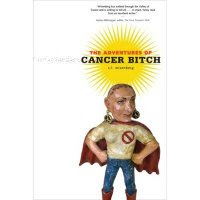
Cancer Bitch on book tour

Cancer Bitch on book tour
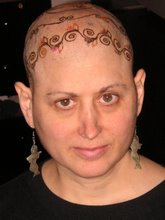
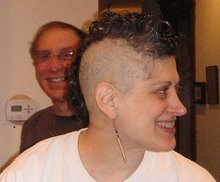
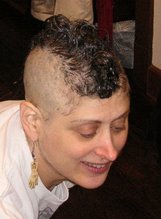
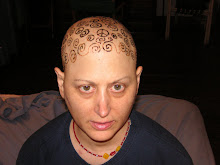
Click on photo for reading dates; the hair came back! photo by Linc Cohen, 10/09

Sunday, November 22, 2009

All solutions are individual.


That's what I learned from reading the Chicago Tribune today, specifically, a little wrap-around page touting itself. But wasn't it preaching to the choir? It should be boasting to people who don't have the newspaper in their hands.

First problem: A pizza deliveryman was mugged and carjacked. Solution: "...people from as far away as South Korean and Germany sent in more than $16,000" so he could return to his pizza route, which I would bet doesn't supply him with health insurance. But that's not mentioned.

The second problem: A reporter wrote about a family living in a storage faculty. Solution: the "generosity of friends, family and Tribune readers touched by their troubles" provided money to put the family up in a motel.

Whew. Problem solved. Don't look to the left or right to see if there's anybody else homeless.

Third problem: A kid was in foster care and he got himself more than $1 million in scholarship offers. I remember reading about this kid. It was a feel-good story. It was the kind of story to make you think, Why don't all the kids pull themselves up by their bootstraps?

Also of note: The Tribune tells us it is "[s]hining a light on the persistent and often ignored problem of youth violence...." Persistent? Yes. Ignored? By whom? Not by the kids who are killed each year and their families. Not by people who live in violent neighborhoods.

Everything was off today. Ask Amy said that doctors should always be called by their titles because of their expertise. Hell, I'm an expert and my students call me by my first name. This is America, talk-show-etiquette America, where everyone has a first name but maybe not even a last. I call some of my doctors by their first names. Sometimes I have to force myself because of all the years of calling doctors doctors but if they call me by my first name, I do the same, especially if they're 20 years younger.

But we subscribe and we read the Tribune and it does give us some information about the city. And suburbs. Even though it is so so embarrassing how every other story seems to be based on a TV show. We can't be treated like real adults; we have to be able to relate our news to broadcast (or digital?) fictional dramas and comedies. We are amusing ourselves to death.

Which is the title of a book by Neil Postman, in which he writes: "What Orwell feared were those who would ban books. What Huxley feared was that there would be no reason to ban a book, for there would be no one who wanted to read one. Orwell feared those who would deprive us of information. Huxley feared those who would give us so much that we would be reduced to passivity and egoism."

Friday, November 20, 2009

...and now Pap smears...


["Curiouser and curiouser."]


Holy Toledo! Now we don't need Pap smears as often. Have we been (the equivalent) of navel-gazing in the past, getting ourselves checked out too often? Our society is paranoid about cancer. Screenings make us feel like we're doing something, like we're being (that horrible corporate word) pro-active. As Sen. Arlen Spector told the New York Times, That is curious.
The past recommendation had been for young women to have Pap smears three years after becoming sexually active. Now the guidelines are to wait until age 21, no matter when a girl started having sex. The numbers bear this out: only two new cases per million teens (15 to 19 years old) per year in the U.S. What if you are one of the two girls? Everything makes sense, statistically, but not if you're one of the statistics.
The old tension between the individual vs. the community.
Cervical cancer is slow-growing, and pre-cancerous conditions often don't turn into cancer. Surgery for the pre-cancerous conditions could lead to premature births, says the Times.
This is the same thinking that went into the decision to recommend mammograms less often. The mammograms picked up non-cancerous tumors, which led to biopsies and more tests, for nothing, I guess you could say. And anxiety. Everyone is worried about our anxiety. I think most women would vote for a little surgery and anxiety so that their anxiety about cancer would be lessened. At least most women who have the choice.
A student of mine this fall thinks she has mono but can't afford health insurance or a visit to a doctor. She assured me last night she was no longer contagious. But she wasn't absolutely sure about the diagnosis, which had been delivered by a guess-timating nurse.
We all need the health insurance coverage that our federal elected officials get. Don't we deserve that?

Tuesday, November 17, 2009

Everything They Told Us Is Wrong...


...or at least it seems so. Now they say that self-exams aren't necessary and that you don't need a mammogram until age 40. I'll have more about this. In the meantime, you can read the study and recommendations here.
If you found your cancer via under-40 mammogram or breast self-exam, please comment! Of course, all comments are welcome, by survivors and non-, as long as you're a real person, not a computer program.
Meanwhile, Our Bodies Our Blog concurs with the guidelines, and explains why, providing important history and perspective, with excellent links. Check it out.

Friday, October 30, 2009

Horrors! Woman touches own breasts on TV!


{Sorry--I couldn't figure out technically how to capture a still of the woman examining her breasts. It is much less sexy than this stock picture from photosearch.com. }

It took a while, but I finally found the un-blurred video from the ABC News local WJLA in Washington, DC., which showed--horrors!--a pretty 28-year-old woman with cancer (before surgery) examining her small, perky breasts. Reporter Gail Pennybacker, thank goodness, warns us beforehand that "Images are going to be graphic." Gosh!! Nipples!! Nipples, which are obscene, are going to be shown. Lock up your women and children! Your children will be traumatized by seeing nipples! Of course, they are not affected by daily, hourly images of war and mutilation--or "action" movies and videos.
The news station brought this all on itself by happening to air this during sweeps week, when viewership is measured. If WJLA wanted to be as blameless as Caesar's wife, it would have run this earlier in the month.
Meanwhile, conservative groups have criticized this display. The AP tells us: The Parents Television Council reacted cautiously to news of the series but suggested it saw the potential for problems.

"We hope that WJLA-TV is not using a crucial public health issue as a ratings stunt, and that the station has fully considered what is appropriate to tell this important story to the public in the most suitable manner possible," the group said in a statement. That might mean different versions of the story at 5 p.m. and at 11 p.m., it added.


I wish the reaction were more outlandish so I could make fun of it. It's also annoying that that first thing that pops up on the PTC web site is a study that says that images of violence against women are on the increase on TV. Really, how can anyone find fault with an organization that cares about violence against women (at least representations of it)? If you read further, you find the organization is Mrs. Grundy-ish (Does anyone say "Mrs. Grundy" any more?) about "indecency" and cursing and sex on TV. Yeah, a lot on TV boils down to immature sniggling about sex, but that's not my most pressing issue.

It's easier to make fun of another critic, Concerned Women for America, which strives "to protect and promote Biblical values among all citizens - first through prayer, then education, and finally by influencing our society - thereby reversing the decline in moral values in our nation." But reading about them makes me more scared than sarcastic. Separation of Church and State, anyone?


[Mrs. Grundy by Walter Crane, 19c]


[not to be confused with Miss Grundy of Archie Comics, pictured at top]


Breast cancer is one thing I do think about a bit. And I was and am lax on breast self-exams. Mostly, the hoopla about the news report is serving to remind me that I need to examine my right breast, that I shouldn't just rely on the six-month mammograms and doctor exams. So ladies, go to it! See instructions and illustrations at this site.

Click here for visuals that are really adult and graphic and for which our country is to blame.

"Murder is a crime; describing murder is not. Sex is not a crime. Describing sex is. Why?" Gershon Legman wrote years ago. I know, I know, this weakens all of the above, because my implied argument is that showing a breast exam is not a smutty, sexual event, but it seemed apropos.

Monday, October 12, 2009

Breast Cancer Drove Her to This


[Imagine a red slash through the smiley face]

The pinkness and cheeriness of the breast cancer industry made Barbara Ehrenreich note the pervasiveness of exhortations to be positive. This is from Saturday's New York Times, by Patricia Cohen:

.....In “Bright-sided,” [Barbara Ehrenreich] traces the roots of the nation’s blithe sunniness to a reaction against Calvinist gloom and the limits of medical science in the first half of the 19th century. Starting with Phineas Parkhurst Quimby, perhaps one of the first American New Age faith healers, she draws a line to Mary Baker Eddy, the founder of Christian Science; the psychologist William James; Ralph Waldo Emerson; Norman Vincent Peale, who published “The Power of Positive Thinking” in 1952; and the toothy television minister Joel Osteen, who preaches the gospel of prosperity.

To Ms. Ehrenreich, the reliance on one’s personal disposition shifts attention from the larger social, political and economic forces behind poverty, unemployment and poor health care. “It can’t all be fixed by assertiveness training,” she said wryly.

Ms. Ehrenreich found that the more she listened, the surlier she became. All that shiny optimism, she said, was “like sitting in a warm bubble bath for too long.” Luckily she found other churlish comrades, scholars and doctors who were similarly skeptical of undimmed positivity.

“We began to call ourselves the Negatives,” said Micki McGee, a sociologist at Fordham University and the author of “Self-Help, Inc.: Makeover Culture in American Life.” The group would meet on occasion and discuss their research and the news of the day. The thread of positive thinking that runs through self-help culture says, “If you dream it and believe it, it becomes reality,” Professor McGee explained. “That kind of thinking contributes to the economic bubble that we just saw explode in enormous ways. Barbara’s take on it is very important.”

Richard Sloan, a professor of behavioral psychology at Columbia, is a more recent member of the Negatives. He has written at length about the absence of scientific evidence showing links between prayer and healing in his book “Blind Faith: The Unholy Alliance Between Religion and Medicine.”

“There is some relatively recent evidence of the benefits of positive affect, but not the simplistic approach that is advocated by coaches that all you need to do is be happy,” he said. “There is no evidence that trying to put on a happy face makes a difference.” Rather, those who are characteristically more optimistic may have an advantage over those who aren’t, but, he said, “you just can’t change who you are very easily.”


Janet Maslin didn't like it so much: http://www.nytimes.com/2009/10/12/books/12maslin.html?_r=1&ref=todayspaper (My linking thing isn't working.)

Sunday, October 11, 2009

Self-conscious Narrators


L took the picture of me above and it didn't seem to look like me. It reminded me of young Leonard Michaels (1933-2003), whom I talked about in class on Thursday. He was known for reading student stories aloud and then stopping when they ceased to hold his interest. Then he'd ask the class to explain why.

I always get him mixed up with Leslie Epstein, who is alive and well and heading the MA-turned-MFA program at Boston U. They don't look alike, though, do they?


I was writing stories in little pieces when I was a grad student writing by instinct. At Iowa I was like an outsider artist with no training in fiction. I had a bachelor's degree, a GRE score but I didn't have any of the basics that everyone else had. I didn't know that a story should have suspense at the beginning, I didn't think about whose story it was, or if the ending was "earned." My friend E read my story in little pieces and said I would like Leonard Michaels' collection, I Would Have Saved Them If I Could, which had stories in pieces. Was I even thinking I might learn from him? Was I looking for a kindred spirit? I don't remember.

I don't remember when I read Leslie Epstein. Maybe it was before I went to grad school. I read The Steinway Quintet plus four. I still remember a line from it, more or less: "Gentlemen, I believe that these are not Jews," said by an elderly member of the quintet when they're about to be robbed. Maybe I read it because I was reading books by faculty at the schools I was applying to. I didn't apply to Boston, though, because it required the literature GRE, and the deadline was late, so I figured I'd wait to see if I heard from any others, and I was accepted by others before the BU deadline. I was successful at applying to grad schools, which in my day was a simple enough thing, once you got your transcripts and test scores sent in, and got the recommenders to send their letters, and all you had to write about yourself was maybe a line or two. Plus of course you sent two stories. Nowadays, you have to write a personal statement and there are dozens upon dozens of MA and MFA programs, and all around the country kids are wringing their hands and worrying and asking each other teeny tiny questions on the MFA blog. They make the Kremlinologists of old look like pikers. There you can also find aceptance rates, so you can figure out if you want to apply to a selective school or very selective school. It is all quite scientific. (Whenever I talk about the olden days, I remember this from a high school play, rendered in a shaky old voice: "I can remember when there were Indians in this very territory. We had to put boards across the street to walk across."--Long Christmas Dinner, Thornton Wilder). And I wasn't even in the play.

There are at least three MFA guidebooks around and several blogs. If we'd had the technology back then in the olden days, would we have asked the same questions and worried as much as these young'uns worry now? I don't know. I do have to say that I don't like the sample personal statement provided on the MFA blog. In case anyone wants to know what I think, after having participated in more than 25 admissions committee meetings, I will tell you: Tell me what you read and what you've learned from what you've read. Tell me what you admire. Tell me how your work has grown up to this point, and tell me how you want your work to grow in our program. Be specific. Do you want to work on point of view, for example? If you're trying to brown-nose us by mentioning our faculty, please be sure to spell their names correctly.

I saw Leslie Epstein on a panel about bad Jews (I think; or did the panelists all claim they were bad Jews?) at a Tikkun conference in Boston in 1990 or 1991. I think it was Epstein. It could have been Michaels. You can read about "Lenny" in Wendy Lesser's book Room for Doubt. Also on the panel was E, my Iowa grad school friend.

I think I got into MFA program(s) because I submitted a story in second person. This was years before Jay McInerny's whole novel, Bright Lights, Big City, was published. It was told completely in the second person. I was influenced by Mary McCarthy's The Company She Keeps, which is one of my favorite books. It's a collection of autobiographical short stories and is clever and brilliant and features a self-conscious narrator. One story,
"The Genial Host," is in second person ("When he telephoned to ask you to do something he never said baldly, 'Can you come to dinner a week from Thursday?' First he let you know who else was going to be there..."). I discovered the book in a neighborhood library in Paris in 1976 or 1977 when I also fell in love with another self-conscious narrator, Christopher Isherwood.


Mary McCarthy

Epstein grew up around LA and his father and uncle wrote the screenplays forCasablanca and Arsenic and Old Lace. Leonard Michaels is the other one, the one who went from East to West, not the other way around.

Thursday, October 8, 2009

The Need for Health Insurance


At present the United States has the unenviable distinction of being the only great industrial nation without universal health insurance.

Health insurance is like elementary education. To function properly, it must be universal and to be universal, it must be obligatory.

Certain interests which think they would be adversely affected by health insurance have made the specious plea that it is an un-American interference with liberty. According to the logic of those now shedding crocodile tears, we ought, in order to remain truly American and truly free, retain the precious liberties of our people to be illiterate, to suffer accidents without indemnification, as well as to be sick without indemnification.

It is by the compelling hand of the law that society secures liberation from the evils of crime, vice, ignorance, accidents, unemployment, invalidity, and disease.
--by Irving Fisher, The Progressive, Jan. 1917